
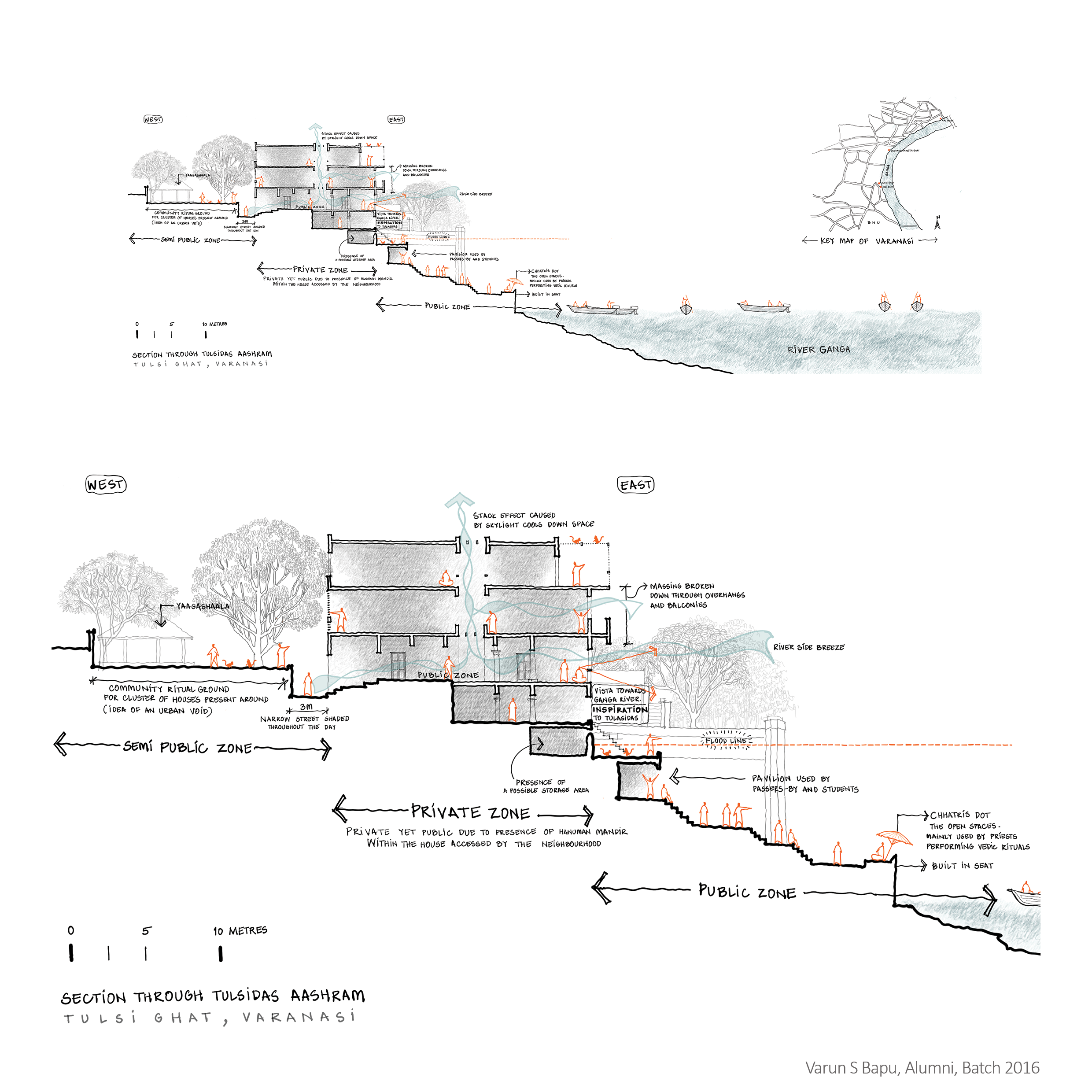
Travel sketching serves as a valuable tool for observation, and has allowed to capture the essence of significant architectural sites across India. This sketch is a digitised version showing the section of Tulsi Ghat in Varanasi, India giving insights into the spaces, landscapes, and design principles of the residence of the saint.
Travel sketching goes beyond mere description and becomes a diagrammatic exercise for observation. Sketches are typically completed on-site to ensure important details are not overlooked. Timing the sketches is crucial during these exercises, helping one determine the level of detail required. The act of detailed sketching aids in preserving spatial qualities for those with photographic memory.
The methodology involves measuring one aspect of a space, such as a grid or height, and then sketching the space in proportion to that measurement. In cases where measuring tape isn’t available, I have used human heights as a reference for relative proportions. The resulting sketches are mostly proportional rather than precise.
Although the base drawing for this was made at site, it was later hand drawn on a digital medium that helped in adding layers of line weights, lighting, activities and annotations that enhances the spatial qualities. The accompanying timelapse shows the process of digitally tracing and adding in the different layers. An elongated cartridge sheet sketchbook is often preferred for longitudinal sections.
Time taken to complete the drawing:
45 min for the measure drawing.
1.5 hours for the digital tracing.
 WCFA Graphic Collective