
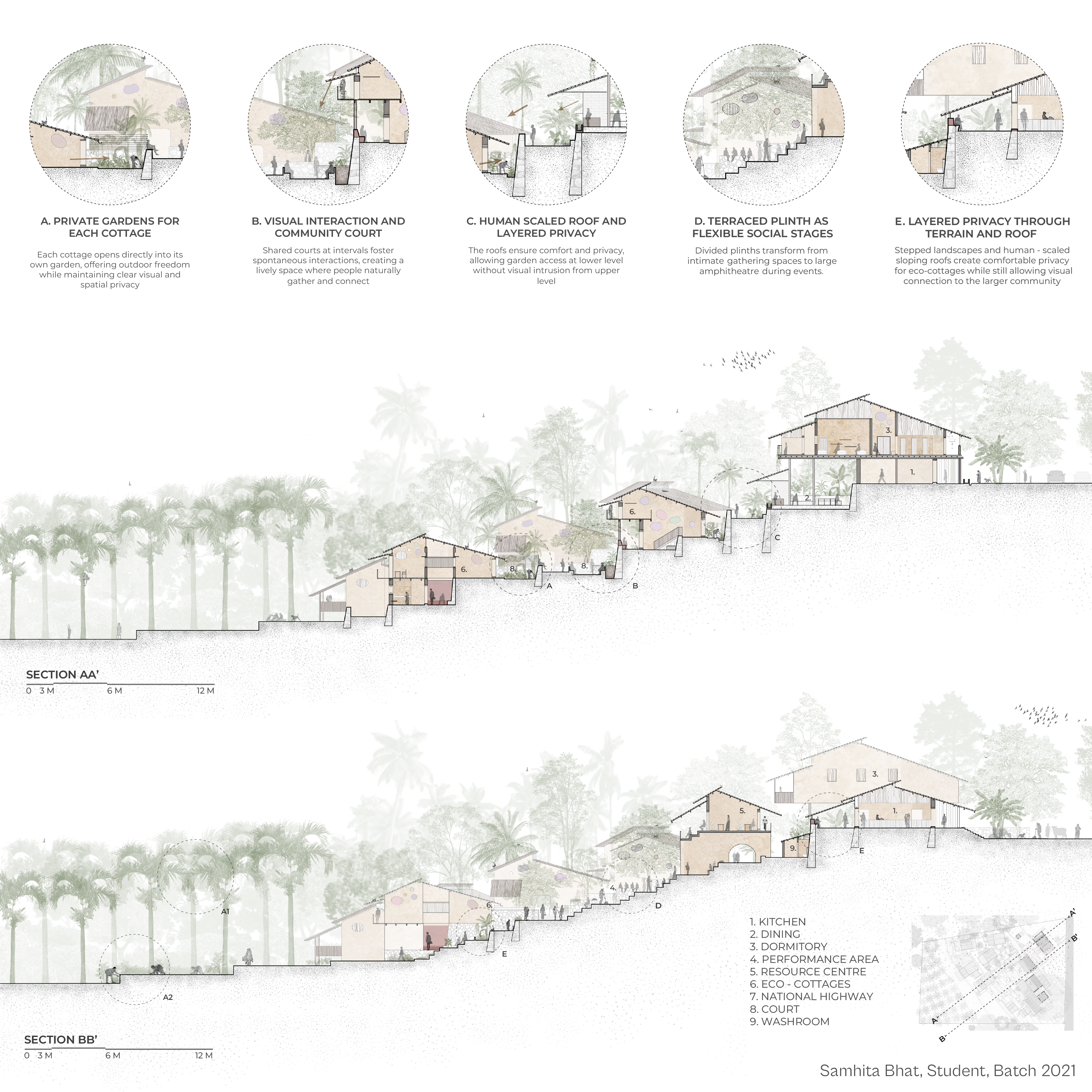
This thesis is based on the belief that our villages are self-sufficient and offer a good, viable alternative to overcrowded cities. This eliminates the need for young people to move away. This intervention is designed to impart knowledge and awareness, providing multiple job opportunities so that even educated graduates can confidently return to villages and thrive. The design prioritizes sustainability, is a blend of contemporary aesthetic with the wisdom of traditional building methods. This is shown by the two sections, which together support the idea of a unified, self-sustaining community.
Section AA’ focuses on the quality of life and social integration necessary to attract and retain residents. The design provides private gardens for cottages at a lower level. It uses layered plinths and human-scaled roofs to ensure visual and spatial privacy between homes. The placement of shared courts at multiple levels ensures constant, informal visual interaction and fosters spontaneous community gatherings. Complementing this, Section BB’ highlights the economic and ecological integration that underpins self-sufficiency. It showcases the working areca landscape flowing into the public realm of the terraced plinth, which acts as a social and cultural stage for community performance and exchange. This visual connection to the working landscape ensures that residents, particularly the youth, feel like a natural and essential part of Devangi’s vibrant production rhythm, ultimately demonstrating how the built environment can catalyze a sustainable ಮರಳಿ ಮನೆಗೆ (Marali Manege).
Thesis Guide: Anne Feenstra
Medium: SketchUp, AutoCAD, Adobe Photoshop
Time Taken: 2 Days
 WCFA Graphic Collective