
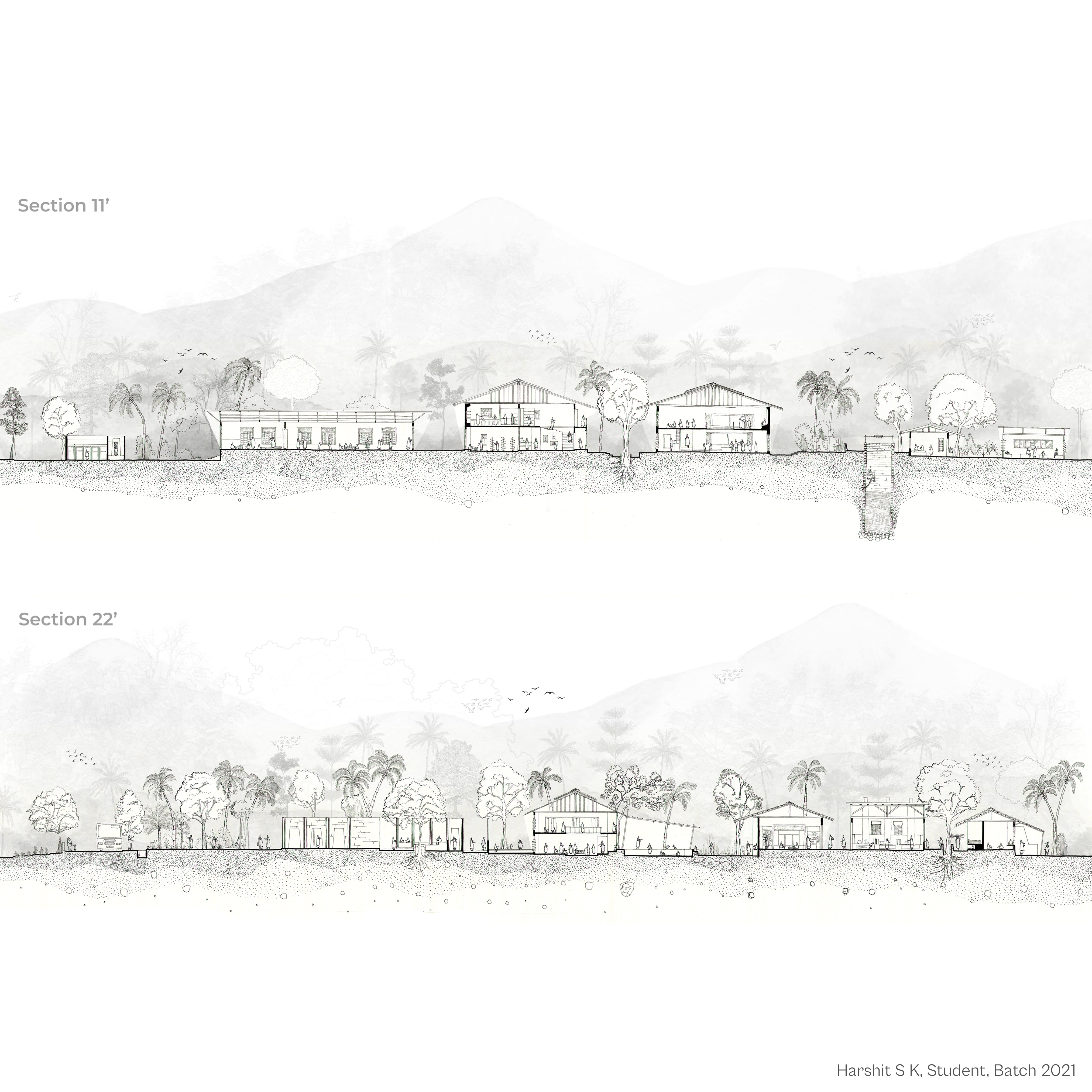
These sectional drawings explain the project as a practical spatial proposal, illustrating how the architecture supports the everyday practices of the Halakki women while rebuilding the conditions needed for their oral traditions to continue in daily life. Rather than presenting isolated rooms, the sections read the building as a sequence of connected activities that move from making, gathering, and learning to care and rest.
Section 11′ explains the working spaces where cultural knowledge is produced and shared. Basket weaving and bead making areas are shown as low-scaled workspaces where women sit together, work with their hands, and exchange skills, songs, and stories. Herb-drying spaces are arranged for stacking and airflow, following traditional methods used by the community. Recording rooms provide spaces where songs and oral narratives can be documented without separating them from everyday practice. The section concludes with the recovery wing, where light, openness, and quieter spaces support rest and healing, extending the idea of care within the Halakki community.
Section 22′ illustrates the public edge of the site and the daily movement of the Halakki women as they arrive and enter the market area to sell fruits and coastal produce. The path then leads through the Songs and Stories Court, sheltered by a rain canopy that naturally becomes a place for people to gather, pause, sing, and share stories. The sequence continues toward the neighbouring school and the community kitchen, where meals are prepared using produce harvested from nearby fields and fruits collected from the forests, linking learning, food, and land.
Together, these sections communicate the larger intention of the thesis to propose a working environment where craft, livelihood, food, gathering, and care take place in close connection. By embedding these activities within everyday spaces, the project creates the practical conditions where songs, stories, and knowledge of the Halakki community in Ankola can be practiced, shared, and carried forward across generations.
Software: Hand Rendered (1682x594mm), Adobe Photoshop
Time Taken: 8 Hours
 WCFA Graphic Collective