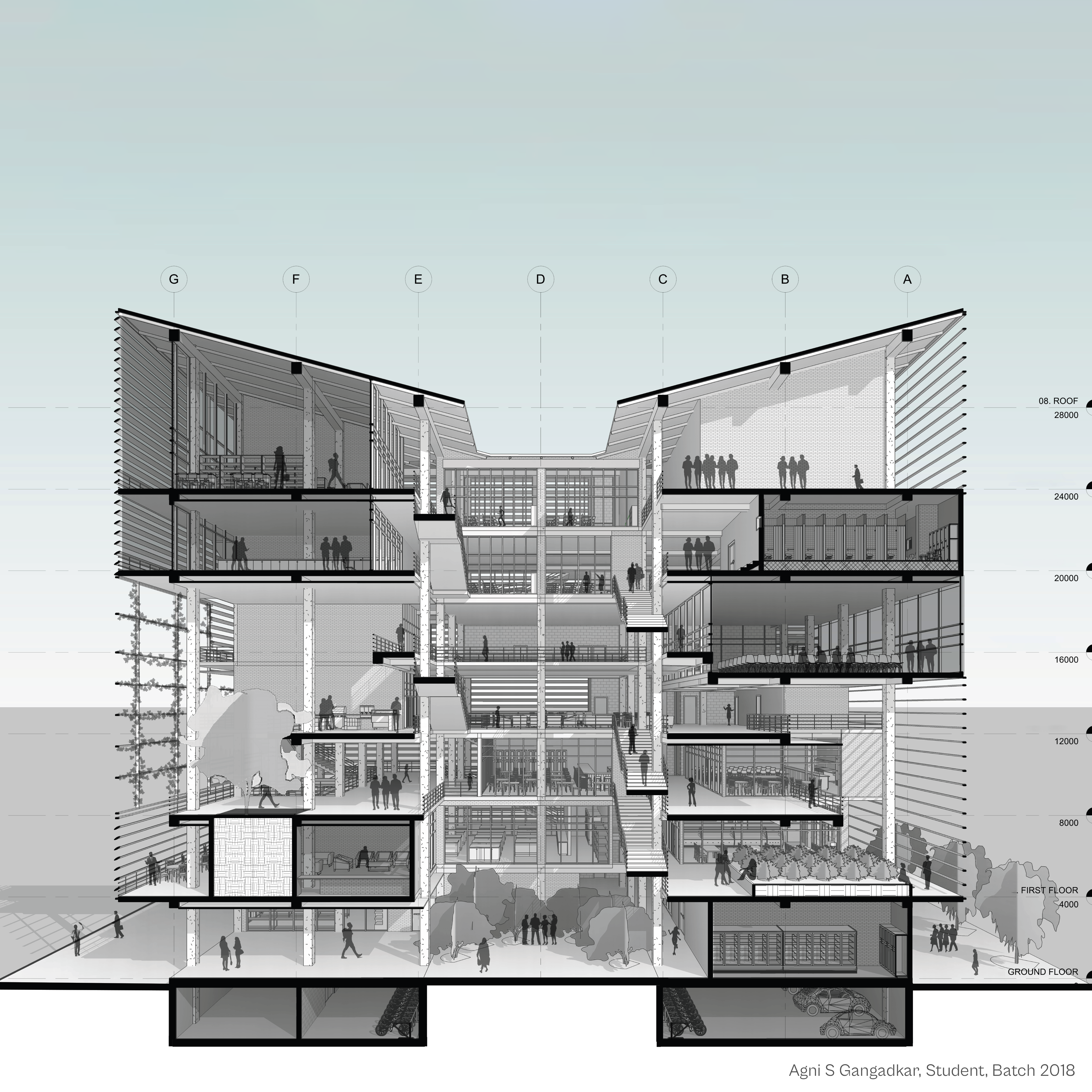
his perspective section illustrates the design evolution of a culinary institute, reimagining the traditional institutional typology as a vertical campus within a tight urban footprint. The building’s form begins with a foundational grid, splitting the mass into three parts on all four sides. A continuous central void is carved from the base to the roof to enable cross-ventilation, maximize sunlight, and maintain internal sightlines. Selective removal of blocks within this grid breaks down the heavy massing, keeping the overall volume visually light while creating diagonal perspectives and varied volumetric experiences.
The program is organized into vertical hierarchies of privacy, described as “shades of public.” The ground floor activates the street with highly public functions such as retail and cookware shops. Mid-levels contain training restaurants, drawing visitors into the heart of the building and allowing them to observe the institute’s inner workings. From here, the sequence transitions through a semi-public buffer before reaching the fully private culinary kitchens and academic spaces at the top.
Each floor plate incorporates open terraces and breakout spaces. Circulation becomes an active design element, with staircases integrated along the outer edges and within the central courtyard to encourage movement, interaction, and visual connections across the volumes.
Software: Revit, Photoshop
Time Taken: 4 Hours
 WCFA Graphic Collective