
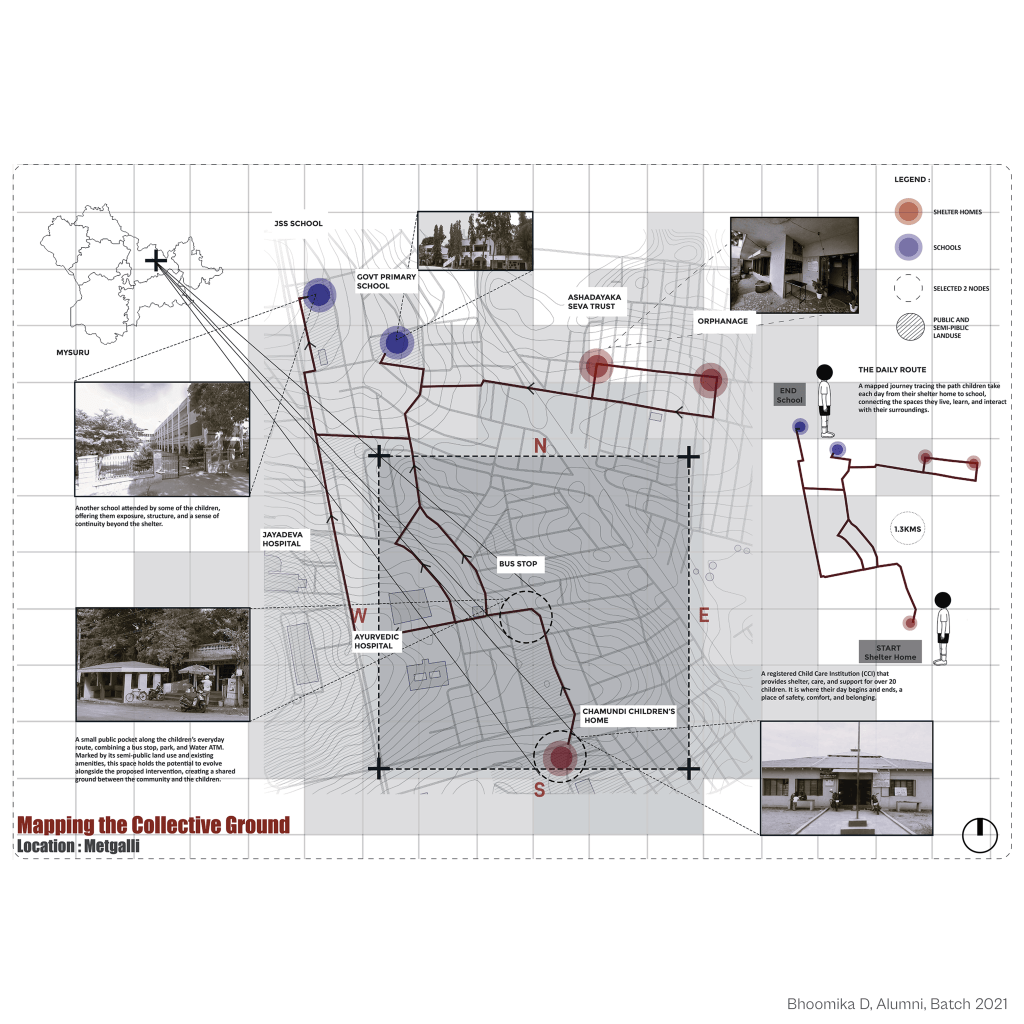
Can the city itself become part of the support system for children who already move through it every day? Kalike Collective explores this possibility through a distributed network of small-scale public inserts for Children in Need of Care and Protection (CNCP), initiated through an NGO-led framework. Rather than concentrating every function within existing shelter homes, the project extends into the surrounding public and semi-public fabric, embedding accessible spaces within the everyday city. This premise led to mapping the children’s existing routes across Mysore alongside shelter homes, schools, public amenities, semi-public spaces, and everyday destinations. The mapping revealed opportunities to position interventions along established journeys rather than introducing additional destinations. Distance, accessibility, intersections, proximity, and existing patterns of use informed the identification of potential nodes, each responding to its immediate context while remaining part of a larger system. The map thus became a generative instrument, translating movement and urban infrastructure into a framework for locating and connecting these interventions. Together, these modest, context-responsive inserts form a wider civic network that extends beyond the institution and becomes embedded within everyday urban life. What begins as a mapping of movement ultimately becomes a proposition for a distributed spatial system, turning everyday urban connections into a framework for intervention.
Softwares : CAD Mapper, Photoshop, Illustrator, Indesign.
Time taken : 1Day

